A Treasury That Mines: 492 TH/s Against Buying at Spot
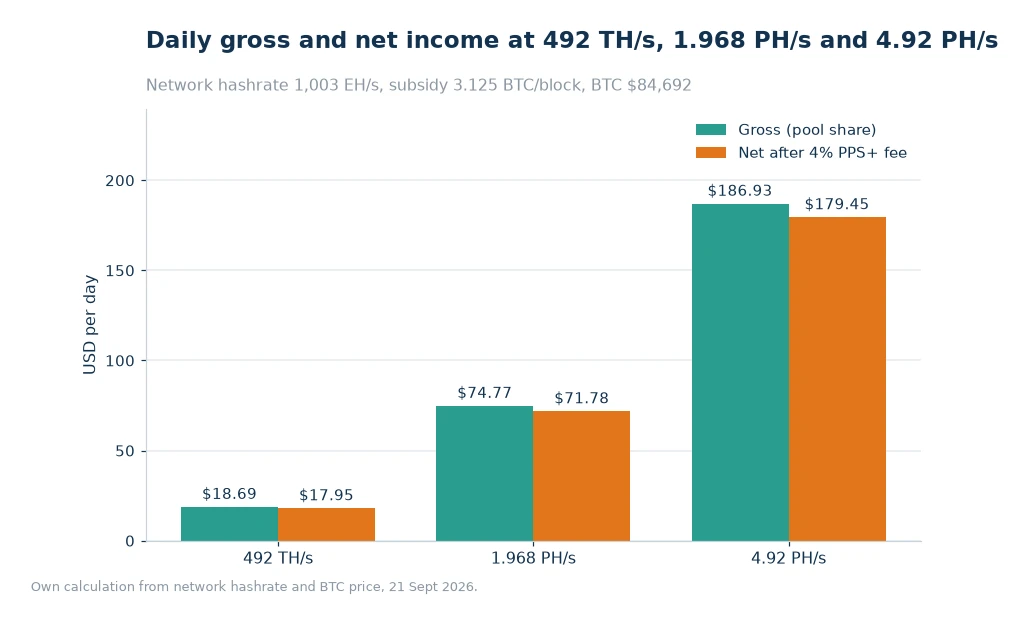
There are two ways to end a quarter holding more bitcoin: buy it, or produce it. Mining at 492 TH/s yields about 0.00022071 BTC a day, which is $18.69 gross at $84,692 and $17.95 after the listed 4% on the block-reward component. Buying gives you the coin today at the market price. Mining gives you a machine, a power bill and a slower, steadier accumulation.
Key takeaways
- 492 TH/s produces 0.00022071 BTC a day, so 0.01 BTC takes about 45 days.
- Mining converts electricity and depreciation into coin; buying converts cash into coin immediately.
- The two routes have different balance-sheet shapes even when the coin total is similar.
- Decide the exit before the purchase: hardware resale is part of the return.
Two routes to the same balance
A treasurer who wants bitcoin exposure has a choice that is usually framed as a price question and is really a timing question. Buying at spot fixes the amount of coin per dollar on the day of purchase. Mining fixes the amount of coin per day, and lets the dollar value of that coin move for as long as the machine runs.
The second route is slower and noisier. It also produces a physical asset and an operating cost, both of which appear on a balance sheet in ways that a spot purchase does not. For a company with spare power capacity and a long horizon, that shape can be useful. For a company that needs liquidity next month, it is not.
Nothing here is a recommendation about which route to take. The arithmetic is the same for everyone; the constraints are not, and the constraints are what should decide it.
What the capital actually buys
A spot purchase buys coin with no further obligation. A mining purchase buys a machine, and the machine comes with three ongoing commitments: energy, maintenance and attention. Those commitments are the reason mining can produce coin below the spot price, and the reason it can also produce it above.
Model the machine as a small factory rather than as a coin. It has a purchase price, a daily input cost, a daily output and a residual value. The output is the only line that moves with the market every hour; the other three are fixed or slowly decaying, which is what makes the operating leverage so sharp in both directions.
That framing also makes the comparison honest. A treasurer who would not buy a factory with the same payback profile should not buy a miner, however attractive the coin chart looks.
One more asymmetry is worth stating. A spot purchase can be reversed in an afternoon, while a mining decision takes weeks to unwind: the machine has to be sold, the power contract renegotiated or ended, and the space released. Liquidity is a feature of the bought position and a cost of the mined one, and it deserves a line of its own rather than a footnote.
| Target | Days needed | Hours of running | USD value at $84,692 |
|---|---|---|---|
| 0.001 BTC | 4.5 | 109 | $84.69 |
| 0.005 BTC | 22.7 | 544 | $423.46 |
| 0.01 BTC | 45.3 | 1,087 | $846.92 |
| 0.02 BTC | 90.6 | 2,174 | $1,693.84 |
Worked example
Take one target and walk it from network totals to a calendar.
- The daily figure for one terahash is 450 ÷ 1,003,000,000 = 0.00000044865 BTC.
- 492 TH/s: 492 × 0.00000044865 = 0.00022071 BTC a day.
- Days for 0.01 BTC: 0.01 ÷ 0.00022071 = 45.31 days.
- Gross dollars at $84,692: 0.01 × 84,692 = $846.92.
- Charge the 4% listed against the reward component: 18.69 × 0.96 = $17.95 a day.
- Monthly net: 30 × $17.95 = $538.50 against 0.00662130 BTC produced.
- Four units at 1.968 PH/s: 0.00088311 BTC a day, $74.77 gross and $71.78 net; ten at 4.92 PH/s: 0.00220786 BTC, $186.93 gross and $179.45 net.
The fourth decimal place matters here. A treasury that rounds 0.00022071 to 0.0002 BTC a day understates its annual output by roughly 9%, which is enough to change the answer on a payback calculation.
The balance sheet differs even when the coins match
Buy coin and the asset is liquid, marked to market every day, with no counterparty. Mine coin and the balance sheet carries a machine that depreciates, a power contract that must be paid, and a coin balance that grows. The two portfolios can hold the same number of coins and still look nothing alike to an auditor.
Depreciation is the line that decides most corporate decisions. A miner loses value through use and through obsolescence, and both are faster than the accounting schedule usually assumes. A three-year straight-line treatment flatters a machine that is economically outclassed in eighteen months.
There is also a working-capital effect. Mining consumes cash daily and produces coin daily, so the treasury holds a position that is partly funded by the power bill. A quarter with a high tariff and a flat price can squeeze a company that would have been comfortable holding the same coins bought outright.
The exit is part of the plan
Hardware resale is a real component of the return, and it is the one most often left out of the model. A machine bought at the top of a cycle and sold two years later recovers a fraction of its price; the same machine bought used and sold after eighteen months may recover most of it. The difference is not luck, it is entry and exit timing.
Write the exit conditions next to the purchase. A target price for the coin, a date, or a performance floor at which the machine is sold regardless of the price. Any of the three is better than none, because the alternative is deciding in the middle of a drawdown.
The buyer of that machine matters too. A used unit sells quickly in a market with buyers who understand it, and slowly in one where they do not, so the resale assumption should be tied to the model's reputation rather than to its age alone. Models with a wide installed base and available spare parts hold value better than a short production run.
If the plan is to hold coin rather than sell it, the Collateral-Pledged Loans route lets a treasury raise liquidity against the balance instead of liquidating it, through Add Collateral, Apply for Loan, Receive Loan, Repay Loan and Redeem Collateral. That is a financing decision with its own risks, and it belongs in the plan rather than in a panic.
ViaBTC Bitcoin Mining reports the daily credit and the running balance in the same account, which is the natural place to reconcile a treasury position against the coins actually received.
Frequently asked questions
How long does 492 TH/s take to produce 0.01 BTC?
About 45 days at the reference difficulty, since the unit credits 0.00022071 BTC a day and 0.01 ÷ 0.00022071 is 45.31.
Is mining cheaper than buying bitcoin?
Sometimes, on an all-in basis that includes power, hardware and depreciation; it is never simply cheaper, because the two routes carry different risks and different liquidity.
What should a company decide before buying miners?
The exit: a target price, a date, or a performance floor, plus how the machine's falling resale value is treated in the accounts.
The multi-currency wallet holds the mined coins and the transaction history behind them, which is the first thing an auditor asks to see.
Put both routes in the same spreadsheet
One column for the spot purchase, one for the miner, the same target in both. Then add the lines that only one side has: power, maintenance, depreciation, resale value, and the time cost of managing a physical asset.
If the mining column still wins after those lines, the decision is defensible. If it wins only when they are omitted, the spreadsheet has answered the question. The Profit Calculator will fill in the revenue side at current difficulty, leaving the cost side to your own numbers.
Sources: ViaBTC loan, calculator and account pages for financing steps and revenue inputs[1]. Published 24 Oct 2026 from 21 Sept 2026 readings: 1,003 EH/s, 132.76 T difficulty, 3.125 BTC subsidy, 144 blocks a day, $84,692 per BTC, next estimate −2.12%. Figures are arithmetic on those inputs.