AI Sexting Explained: Text-First Adult Conversation
Text is a slow medium, and that is its main feature rather than a limitation. Nothing arrives until someone types it, the reply can be re-read before it is sent, and the whole exchange leaves a record you can scroll back through. On an adult platform this changes pacing, tone and expectations at the same time — and the numbers on the trend cards, from about 0.018% to 0.053% favourites per view, suggest most readers reward a slower, more deliberate register.

Key takeaways
- Text removes the cues that carry most of the meaning in conversation, so pacing has to be written into the messages instead.
- Favourite-to-view ratios on the trend cards span roughly 0.018% to 0.053%, a threefold spread in how well listings hold the people who open them.
- Re-reading is free. Unlike speech, a message can be edited or abandoned before it exists for anyone else.
- Expectations are set by the description, not by the marketing word, so choose what you open by the tone the listing promises.
What the medium actually changes
Spoken conversation runs on timing, pitch and expression. Text carries none of them, so everything that would have been implied has to be stated. That is why a text-first exchange can feel slower at the start and richer later: the receiver is not guessing at your tone, because the tone is in the words.
The second change is asynchrony. Because nothing is delivered until it is written, there is no cost to pausing. A reply can be considered, shortened or dropped entirely before it exists for the other side. In any adult conversation this is the single most useful property of the format, and it is worth using deliberately rather than treating the chat box as a telephone.
The third change is the record. A text thread is reviewable in a way that a conversation is not. You can read back what was established earlier, which is exactly what a persistent context feature such as the one Crushon provides makes possible — characters that remember previous interactions and adapt over time. On the sex ai chat page the platform describes exactly this behaviour, alongside the phrase Sex AI companions and the promise that replies adapt to your personality and remember your preferences.
Pacing, from both sides of the box
Pacing in text has three dials. Message length sets the effort level: a long message invites a long reply, a fragment invites a fragment. Message frequency sets the tempo, and a burst of three short messages feels different from one paragraph carrying the same content. Sentence rhythm sets the register — clipped sentences read as urgent, compound ones as considered.
Most dissatisfaction with a new thread traces back to mismatched dials rather than a bad character. If you write three paragraphs and receive one line, the pairing is out of alignment; adjusting the longer side down usually fixes the exchange faster than hunting for a different listing. It is a two-way adjustment and it is easier to make while the thread is still short.
There is a plain way to measure that alignment over the first ten exchanges. Count how many of your messages introduce something new — a setting, a mood, a small decision — and how many merely react. A thread where both sides keep introducing material holds up; one where only you do thins out within a dozen messages however good the listing looked. Illustratively, ten introductions spread across two weeks at two or three per session is a natural rate, while ten in a single sitting is not.
| Dial | Low setting reads as | High setting reads as |
|---|---|---|
| Message length | Detached, brisk, uninterested | Invested, deliberate, demanding of a matching reply |
| Frequency | Patient, unhurried, open to gaps | Momentum-driven, expects presence |
| Sentence rhythm | Urgent and fragmentary | Considered and conversational |
| Reply ratio | One question, one answer | A thread that adds detail on both sides |
Worked example
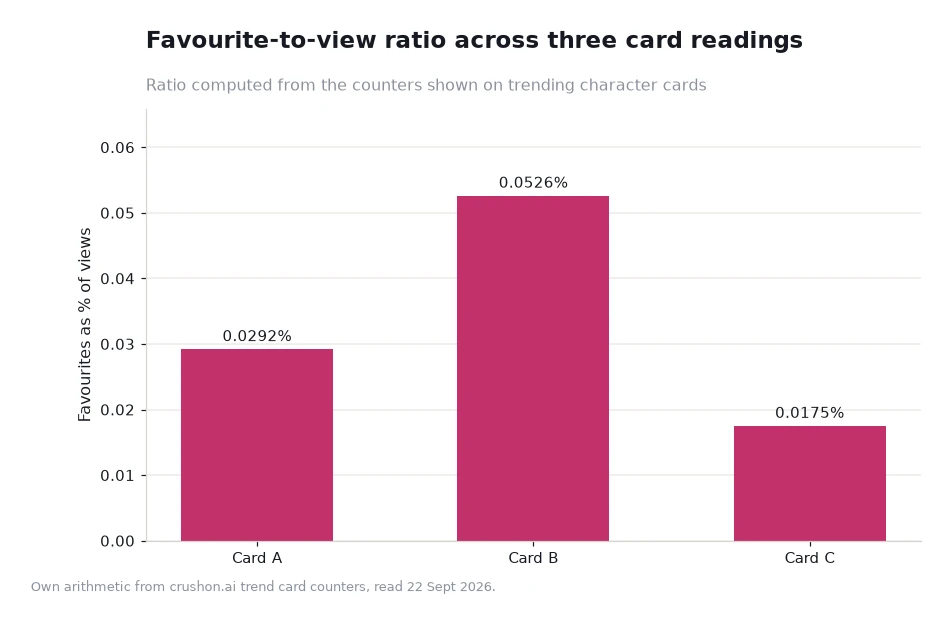
The trend cards give a real ratio to work with. Eri shows 24.3M views and 7.1K favourites; 7.1K divided by 24.3M is about 0.0292%. Eva shows 19.1M views and 2.8K favourites, which is about 0.015%. Takara shows 18.2M and 4.7K, about 0.026%. On the chart below the same readings appear as Cards A, B and C, spanning a low of 0.0175% and a high of 0.0526%.
Convert those to a per-10,000 basis and the gap becomes easier to feel. A ratio of 0.0292% means 2.92 favourites for every 10,000 views. A ratio of 0.0526% means 5.26. A ratio of 0.0175% means 1.75. The best reading in the set is therefore about three times the weakest, and that factor is the difference a slower, more consistent register tends to make.
Run the same arithmetic on your own habits, as an illustration rather than platform data: five sessions a week at 12 minutes each is 60 minutes a week, 240 minutes a month, or about four hours. Spread over a month, that is roughly eight minutes a day — enough for a handful of considered messages rather than a long burst, which is the pacing that fits a slow medium.
Tone, expectations and the honest frame
Tone is set before the first message, in the listing description. Reading it as a promise rather than a label saves time: a listing that describes a considered register will not reward clipped fragments, and one built for quick exchanges will not reward paragraphs. Expectations also need one correction up front. The platform states that its content is AI-generated text, that it depicts no real person, and that it does not produce images or video. Anything you are looking for beyond that is not what this medium offers.
The remaining expectation is about limits. Latitude in adult roleplay is not the same as an absence of rules, and the platform's FAQ is explicit that some limitations apply under its content and community guidelines. If you want a wider view of what people are choosing to read, the AI chat blog and the character search view are the calmest places to see the range before starting a thread of your own.
Frequently asked questions
Is a longer message always better?
No. Length signals the effort you expect back. The reliable rule is to match the length you receive, then move both sides up together rather than jumping ahead.
Why do the cards show both views and favourites?
Views show how many people opened a listing; favourites show how many kept it. Eva's 19.1M views with 2.8K favourites is about 0.015%, less than half Eri's 0.029% on 24.3M.
Does the conversation remember earlier sessions?
The platform describes characters that recall previous interactions and adapt over time, which is the feature that makes a returning thread different from a first one.
Write for the medium, not against it
Set the three dials before you start: how long, how often, and how clipped. Then match the level the thread comes back with instead of pushing your own setting upward.
Finally, protect the slow part. The pause before sending is what separates text from speech, and it is the one advantage that never goes away no matter how fluent a reply becomes. Adults 18 and over only.
Data and sources: favourite and view counters shown on the Crushon trend cards[1], plus the sex AI companions page and its FAQ wording, read 22 Sept 2026. Ratios are arithmetic on those counters; session and minute figures are illustrative assumptions. Content is AI-generated text and depicts no real person. Intended for readers aged 18+.